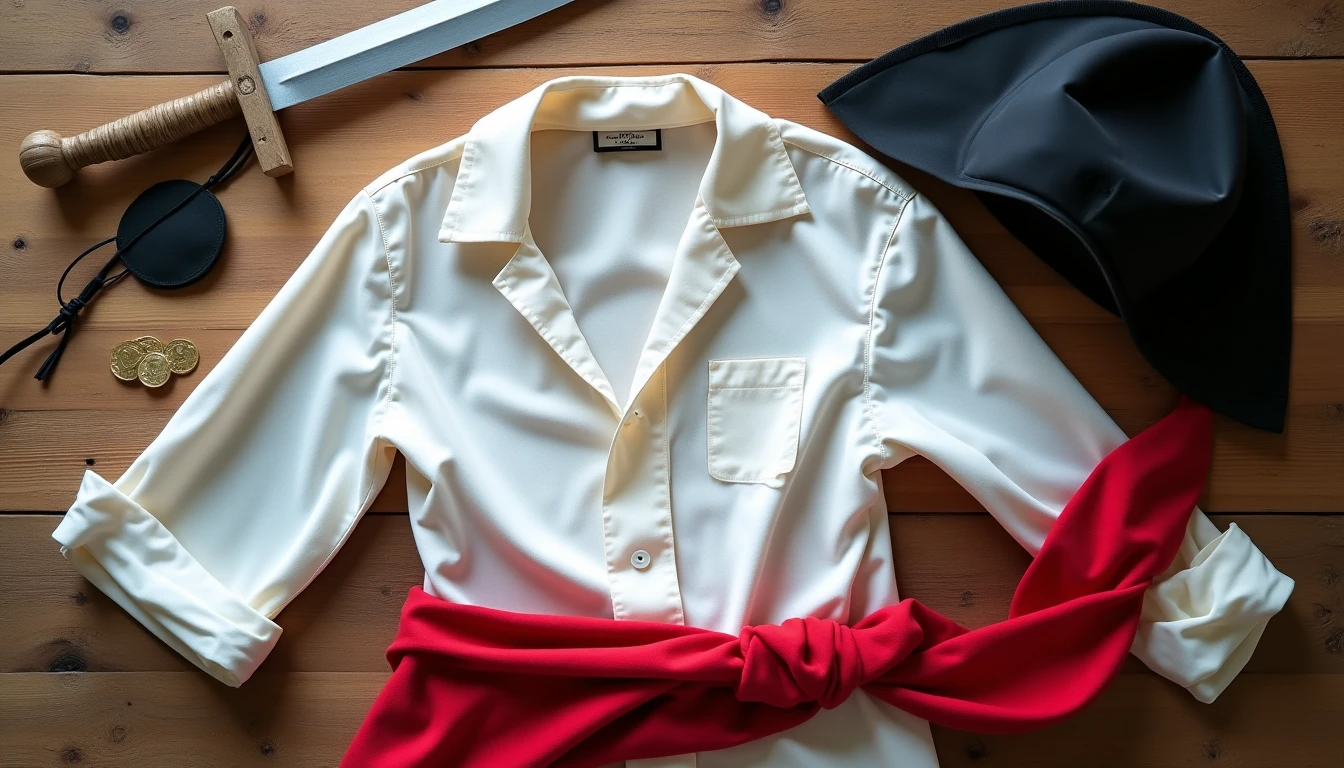
A DIY pirate costume might be the most forgiving costume you can put together. Pirates didn’t dress to match, they dressed in whatever they had on hand, so your closet and the nearest thrift store already have most of what you need. An oversized shirt, a pair of pants you don’t mind cutting up, and a scrap of fabric for a sash get you most of the way there.
For more ideas, browse our halloween costume ideas hub, or see how to make a costume for the general process this build follows.
Some links below are affiliate links. Prices are 2025-2026 estimates and change often, so always check current pricing.
The Pirate Formula
A pirate costume is really a handful of shapes stacked together. Hit most of these and the look reads instantly:
- A billowy, oversized white or off-white shirt, the single most important piece. Volume beats fabric quality.
- Pants or a skirt with an uneven, jagged, or frayed hem: cropped mid-calf on men, or a tattered maxi or handkerchief-hem skirt on women.
- A sash or wide belt at the waist. A tied-on fabric rectangle works as well as anything store-bought.
- A vest or waistcoat layered over the shirt.
- A bandana tied pirate-style, or a folded tricorn hat.
- Boots, or felt spats over sneakers.
- Two or three finishing accessories: eye patch, sword, jewelry.
For closet-sourcing, an oversized men’s button-down gives you the poet-shirt effect for free, black leggings or dark jeans work as a pants base before distressing, a full maxi skirt becomes a pirate skirt with a few cuts, any wide fabric belt doubles as a sash, and an old blazer with the sleeves removed becomes a waistcoat.
The Classic Adult Pirate
- Start with a plain white, cream, or off-white button-down, thrifted, borrowed, or a size or two too big. Bigger matters more than fabric quality since the extra volume sells the look.
- Untuck the shirt, roll the sleeves to the elbow, and leave two or three top buttons open. A lightweight sash tied at the waist hides bulk and holds a prop sword.
- For pants, use black or brown trousers or dark jeans. Mark a jagged, uneven line around each leg with chalk (varying the height so it looks torn, not measured), cut along it, then hand-pull threads at the edge to fray it. Stitch an inch above the frayed edge if you want to stop it from unraveling further.
- Layer a brown or black vest over the shirt, an old suit vest or one cut from a blazer with the sleeves removed, and leave it unbuttoned or fastened only at the bottom.
- Add a wide belt with an oversized buckle over the sash. A thinner second belt or chain on top reads as well-traveled rather than matched.
- Finish with a head scarf or tricorn hat, boots (or felt spats over regular shoes), and light face grime: smudged eyeliner for stubble, bronzer along the jaw for a sun-worn look.
A Pirate Look With Skirts and Lacing
- Base the top on a peasant blouse, either an off-the-shoulder piece you own or a DIY version made by threading elastic through a casing at the neckline and sleeves.
- Fake a corset without boning: pin small fabric loops down the front of a fitted vest about 1.5 inches apart, then lace ribbon through them crisscross-style over the blouse for an instant bodice line.
- Build the skirt from a handkerchief hem. Fold a fabric square diagonally into quarters, cut a small circle from the folded point for the waist opening, then layer a second square rotated 45 degrees so the points fall unevenly around the hem. A dark maxi skirt with the hem torn into points is a faster no-sew substitute. See how to sew a skirt for the base technique.
- Add a sash, a bandana through the hair, hoop earrings, and layered coin necklaces.
- Finish with boots or felt boot covers over flats and smudged bronzer for a windswept face.
Kids and Toddler Pirates
Speed and comfort come first here. The fastest build is an oversized t-shirt or button-down, dark leggings with the hem cut into rough points, a fabric sash, and a no-sew felt vest.
To make the vest, fold felt in half, lay one of the child’s own t-shirts on top as a tracing template for the neckline, shoulders, and armholes, and cut the shape while leaving the shoulders connected so it opens like a poncho. Felt doesn’t fray, so raw edges are fine as-is. Secure the front with fabric glue, safety pins, or hook-and-loop dots. A felt tricorn or bandana, a felt eye patch on elastic, and a cardboard cutlass finish the look in under an hour with zero machine sewing.
For toddlers and babies, keep it soft and safety-first. A striped or white onesie works as the base shirt, a sash tied loosely (or sewn shut so it doesn’t need real tying) adds the pirate line, and a soft bandana is safer than any hat with a chin strap. Skip small parts entirely for children who still mouth objects: no button eye patches, no cardboard hooks, no loose beads. A drawn-on eye patch with a face-safe crayon, or a felt patch glued to a headband, plus a skull-and-crossbones in fabric paint on the onesie, reads as pirate without any small or sharp pieces.
Light Sewing Upgrades
Head scarf. Cut a cotton square about 20 to 22 inches per side, fold it diagonally into a triangle, and finish the raw edges with a narrow rolled hem. See how to hem for the technique. Place the long folded edge at the hairline, wrap the ends around the head, tie at the back, and tuck the point up under the knot.
Fabric sash. Cut a rectangle roughly 10 to 12 inches wide and 60 to 70 inches long, fold it in half lengthwise right sides together, stitch the long edge and one short end, turn it right-side out, press flat, and hand-stitch the opening closed. A true fabric tube reads more “pirate” than a purchased belt.
No-closure felt vest. Same tracing method as the kids’ vest above, sized to an adult t-shirt: leave it open and belted, or add a glue or hook-and-loop closure.
Handkerchief-hem skirt. Fold a fabric square diagonally into quarters, cut a curved notch at the point for the waist opening, and unfold it into a square with a round hole in the middle. Layer a second square rotated 45 degrees for a fuller, staggered hem. Finish the waist with an elastic casing and hem the outer edges. Full base steps at how to sew a skirt.
Accessories You Can Make Tonight
Eye patch. Cut two matching oval shapes from black felt, sandwich the ends of a piece of black elastic cord between the layers, then stitch or hot-glue around the edge.
Tricorn hat, from a felt hat. Start with an inexpensive wide-brim felt hat. Fold the brim up against the crown in three places to form a triangle from above, and tack each fold with a stitch, hot-glue dot, or pin.
Tricorn hat, from scratch. Glue a felt strip into a head-sized band, attach a tabbed felt circle to close the crown, glue a donut-shaped felt brim to the bottom of the band, then fold the brim’s outer edge up into three points and glue each one to the crown. A pack of felt sheets in a few colors covers the hat, vest, eye patch, and boot covers in one purchase. Kids’ versions use the same folding trick in black craft paper instead of felt.
Cardboard cutlass and hook hand. For the cutlass, draw a curved blade and hilt on flattened cardboard, cut two matching layers, glue them together for rigidity, then paint the blade silver and the hilt gold or brown. For the hook, cut a hole in the bottom of a paper cup, twist pipe cleaners into a hook shape, push the straight end through the hole, and wrap the whole thing in foil.
Parrot and jewelry. Attach a small stuffed parrot to a shoulder with a safety pin or a loop of elastic sewn to its underside. Hoop earrings and layered necklaces from your jewelry box read as pirate treasure instantly, or cut cardstock circles, cover them in gold foil, punch a hole, and string them on cord for DIY coins.
Boot covers. Wrap felt around the shoe, overlap it at the back, glue or stitch the seam, then fold the top edge down into a cuff. Elastic along the bottom helps it stay put over sneakers.
Aging and Finishing Touches
Tea-staining is the standard way to age fabric. Boil water, steep several tea bags in it (more bags for a darker stain), then simmer the fabric directly in the pot for up to an hour, stirring so it stays submerged. Scrunching the fabric before dyeing gives a mottled, weathered look instead of a flat color. Rinse in cold water (a vinegar rinse helps set the stain) and dry as usual. This works best on natural fibers like cotton, linen, and wool, since synthetics resist the tannins.
Beyond tea-staining, fray cut hems by hand-pulling threads loose or scrubbing edges with sandpaper, and add a few strategic rips with scissors rather than shredding at random. For makeup, a dark brow pencil smudged along the jaw gives instant stubble, a thin drawn scar adds character, and bronzer along the forehead gives a sun-worn look. For hair, loose braids with beads woven in or a scarf knotted at the nape both read as pirate-appropriate.
If you want a whole library of patterns to pull from for this costume and everything else on your sewing list, our pattern library has 155+ printable PDF patterns you can print at home: check out the pattern library.
Frequently Asked Questions
How do you make a pirate costume at home?
Build it in layers from the closet outward: an oversized white or off-white shirt for volume, dark pants or a skirt with the hem cut into an uneven, ragged line, a sash at the waist, and a vest layered on top. Add a bandana or tricorn hat, boots (or felt boot covers over regular shoes), and an accessory or two, like an eye patch or cardboard sword. Almost none of it needs a sewing machine.
How do you make pirate pants look ragged?
Mark a jagged, irregular line around each pant leg with chalk, varying the height so it looks torn rather than measured, then cut along the line. Hand-pull a few threads at the edge to fray it, or rub the raw edge with sandpaper for extra wear. Stitching an inch above the cut edge stops the fraying from going too far.
How do you make a tricorn hat?
The fastest method starts with an inexpensive wide-brim felt hat: fold the brim up against the crown in three places to form a triangle from above, then tack each fold with a stitch, hot glue, or a pin. To build one from scratch, glue a felt strip into a head-sized band, attach a tabbed felt circle to close the crown, attach a donut-shaped felt brim to the band, then fold the brim up into three points and glue each in place. Kids’ versions work the same way in craft paper.
How do you tea-stain fabric?
Boil water and steep several tea bags in it, the more bags the darker the stain, then simmer the fabric directly in the pot for up to an hour, checking often and keeping it submerged. Scrunching the fabric before dyeing creates a mottled, aged look instead of a flat color. Rinse in cold water (a vinegar rinse helps set it) and dry as usual. It works best on natural fibers like cotton, linen, and wool.
What do I need for a kids’ pirate costume?
An oversized shirt, dark leggings with a roughly cut hem, a fabric sash, and a no-sew felt vest traced from one of the child’s own t-shirts cover the base outfit. Add a bandana or felt tricorn hat, a felt eye patch on elastic, and a cardboard cutlass or foil-wrapped hook for finishing touches, all achievable without a sewing machine.
How do you tie a pirate head scarf?
Fold a square bandana in half diagonally into a triangle, place the long folded edge across the forehead an inch or two above the eyebrows, tilt the head back slightly so the fabric covers the scalp, then pull the two ends around to the back of the head and tie a double knot. Tuck the triangle’s point up under the tied ends to finish.