A sewing pattern is a blueprint. It tells you what shape to cut your fabric and what order to sew the pieces in, but owning one and knowing how to use it are two different things. You can buy the prettiest envelope on the shelf or download the most popular PDF of the year, and it will still sit in a drawer if you don’t understand what’s inside it.
That’s what this guide is for. We’ll walk through what a pattern actually contains, how the paper-versus-PDF-versus-projector landscape works today, why pattern sizes almost never match your store size, and how to pick a first pattern that won’t fight you. If you’re brand new to sewing altogether, start with our guide to sewing for beginners, and if you want the full path from fabric to finished garment, see how to sew clothes.
Some links below are affiliate links. Prices are 2025-2026 estimates and change often, so always check current pricing.
What a Sewing Pattern Actually Is
Strip away the branding and every sewing pattern is made of the same two things: pieces and instructions.
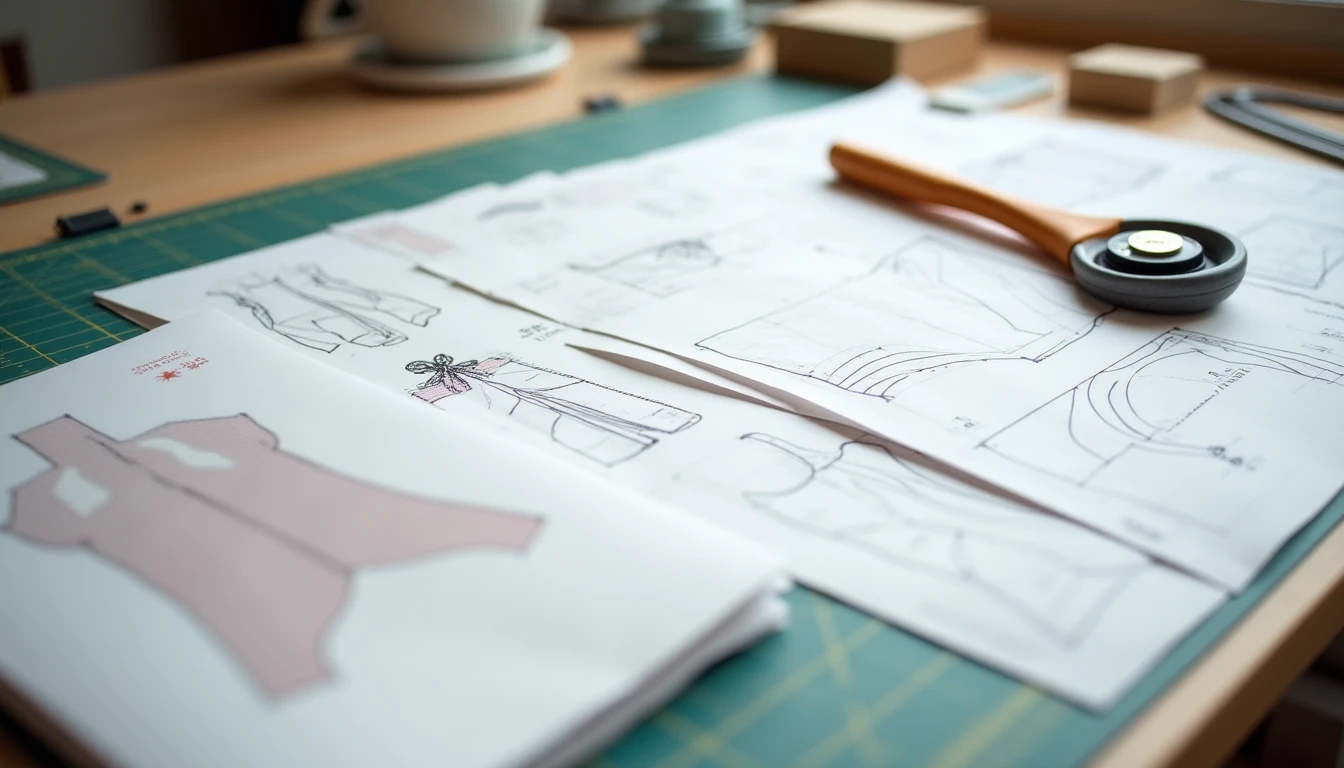
The pieces are flat templates, one for each cut section of the garment. A simple top might have a front bodice, a back bodice, a sleeve, and a facing. A tailored jacket might have a dozen pieces once you count collars, pockets, linings, and interfacing. Big-4 patterns print these on thin tissue paper, indie envelope patterns often use heavier paper, and PDF patterns arrive as a digital file you print or project yourself. Whatever the material, each piece carries the same markings: a cutting line, a grainline arrow showing how to lay it on the fabric, notches and dots for matching seams, a fold line where relevant, and a name or number to tell it apart from the rest.
Alongside the pieces comes an instruction sheet, or in most PDF and indie patterns, a separate digital booklet. This includes a cutting layout diagram showing how to arrange the pieces on your folded fabric to use yardage efficiently, a key explaining each symbol and marking, and numbered construction steps illustrated with line drawings. Indie brands increasingly go further, pairing the written steps with photo-based or video sew-alongs and full-color booklets, a step up from the small newsprint-style sheets that ship with a typical Simplicity, McCall’s, Butterick, or Vogue pattern.
Many big-4 and plenty of indie patterns are also “multi-size,” or nested: one pattern piece prints several cutting lines at once, one per size, so a single purchase might cover sizes 4 through 12 on the same sheet of tissue. You trace or cut along the line for your size. Cut directly on the tissue and you’ve destroyed every other size on that sheet, which is why most sewists trace nested patterns onto tracing paper instead of cutting the original.
Then there’s the detail that trips up more beginners than anything else: seam allowance, the extra fabric between the cutting line and the sewing line. Whether it’s already built in depends entirely on the publisher. Big-4 patterns (Simplicity, McCall’s, Butterick, Vogue) include a standard 5/8 inch (1.5cm) seam allowance right in the cutting line, so you cut on the printed line and sew at 5/8 inch unless a step says otherwise. Burda is the split case worth knowing by name. The burda style magazine patterns, the sheets folded inside the monthly magazine, do not include seam allowance at all. You trace the printed line as your sewing line and add your own allowance when cutting, commonly 3/8 to 3/4 inch for seams and about 2 inches for hems. Burda’s separately sold envelope patterns, the packaged ones sold in fabric stores, generally do include seam allowance, confirmed by a red-and-white star on the envelope. An envelope without that star still needs the allowance added by hand. Several independent European and Japanese pattern books follow Burda’s no-allowance convention too, so the safest habit is to check the envelope, the PDF layer notes, or the instructions every time rather than assume.
The Pattern Landscape
Once you start shopping for patterns, you’ll run into four broad categories, and it helps to know how each one got to where it is today.
The big-4 is the shorthand for Simplicity, McCall’s, Butterick, and Vogue Patterns, the legacy American pattern companies most sewists grew up with. They’ve been under one corporate roof since 2017, but the roof has changed hands more than once, most dramatically in the last year. McCall Pattern Company, Butterick, and Vogue were consolidated under CSS Industries, which bought McCall’s in December 2016 and then Simplicity Creative Group, adding Simplicity and Know Me, in the fall of 2017. UK-based IG Design Group acquired CSS Industries in January 2020 for roughly $88 million, folding the brands into its Americas division. Then, citing tariffs, a softening craft market, and Joann’s bankruptcy, IG Design Group sold that US division on May 30, 2025 to Hilco Capital, a liquidation firm, for nominal terms. The pattern lines were sold again in September 2025, this time to Rubelmann Capital, and on October 30, 2025, Simplicity Patterns relaunched as an independent, employee-led brand under pattern-industry veteran Abbie Small, continuing Simplicity, Vogue Patterns, McCall’s, Butterick, New Look, and Know Me by Mimi G under one company. In 2026, the relaunched brand introduced new Gunne Sax patterns and a Vintage Vault reissue line. Three ownership changes in under a year sounds chaotic, but the practical upshot for sewists is simple: the patterns, sizing, and seam allowance conventions you already know haven’t changed.
Burda sits apart from the big-4, both in ownership and in feel. It’s a German publisher known for on-trend, fashion-forward styling, and it operates in two parallel formats. The burda style monthly magazine bundles dozens of patterns onto large nested sheets that must be traced off, with no seam allowance included, as covered above. Burda also sells envelope patterns separately in fabric stores, and those behave much more like big-4 patterns: cut-and-go, with seam allowance typically included.
Indie designers are the newer wave, usually small or single-founder companies selling mostly as PDF downloads, with occasional small print runs. Closet Core Patterns (which has also folded in other indie lines such as Deer and Doe), Tilly and the Buttons, Seamwork, Grainline Studio, and True Bias are all well-established names here. Grainline’s Scout Tee, in particular, gets recommended constantly as a first woven top. Indies tend to offer more modern, often video-supported instructions, active designer support through Q&A and Facebook groups, community sew-alongs timed to new releases, and wider size ranges than legacy big-4 grading, though most also cost more per pattern than a big-4 sale price.
PDF mechanics are worth understanding before you buy your first digital pattern. You’ll print it one of two ways. Print-at-home tiles the file across standard letter or A4 pages, which you trim and tape together using printed alignment marks, a process that can take 30 to 90-plus minutes for a garment with many pieces. Copyshop or A0 printing uses the same file’s single large-format page, roughly 36 by 48 inches, sent to a print shop and returned pattern-size with no trimming or taping. Well-built PDF files also include a layers feature, letting you toggle off every size but your own before printing so you’re not squinting through a maze of nested lines.
Projector sewing is the newest wrinkle, and it’s more established than it might sound. Sewists discovered around 2019 that a projector, mounted overhead on an arm or ceiling mount and connected to a computer or tablet, can display a PDF pattern file at full scale directly onto fabric laid on a cutting table. You calibrate the projected image to true size using an on-screen ruler or grid, then cut straight through the fabric with the pattern projected on top, skipping printing, taping, and paper entirely. Free tools like Pattern Projector, an open-source app built for calibration and page-stitching, support the method, and there’s an active Facebook community called Projectors For Sewing along with how-to hubs like ProjectorSewing.com, Sew Into That, Homemade Emily Jane, and Made by Rae. The draw is reusability and zero ongoing paper or ink cost, though the projector and mount are an upfront investment.
And if none of this appeals because you’d rather not spend anything at all, our free sewing patterns guide rounds up the verified sources worth knowing.
Paper vs PDF vs Projector
There’s no single best format. Each trades cost, convenience, and storage against each other differently, so the right choice depends on what you value most right now.
| Format | Cost | Access | Assembly | Reuse | Storage |
|---|---|---|---|---|---|
| Paper envelope (big-4/indie) | Moderate per pattern, $4-25 typical, big-4 often discounted in sales; no printer or ink needed | Requires shipping or an in-store purchase, not instant | None, pieces are pre-cut tissue, ready to trace or cut | Reusable indefinitely if traced (cutting a multi-size original limits it to one size) | Bulkiest physical format, envelope plus folded tissue needs a drawer, box, or filing system |
| PDF print-at-home | Usually cheapest per pattern, $0-15, plus ongoing home ink and paper cost | Instant download after purchase | Highest time cost: print tiled pages, trim, tape together (30-90+ minutes depending on piece count) | Fully reusable, the file can be reprinted anytime and size layers toggled | Digital file takes no physical space; assembled paper pattern still needs storage like any paper pattern |
| PDF copyshop/A0 print | Pattern cost plus a per-print fee at a copyshop or online large-format printer, roughly $5-15 per job | Instant file download, but printing adds a wait (in-store same day, mail order a few days) | None, arrives as one full-size sheet, no taping | Fully reusable file, can reprint or send straight to a projector setup instead | Same as a paper pattern once printed; the digital file itself is compact |
| Projector sewing | Highest upfront cost, projector plus mount often $150-500+, but zero ongoing paper or ink cost after that | Instant, using the same PDF file the moment it’s purchased | None, pattern is calibrated once per project and projected directly onto fabric | Unlimited reuse of the same digital file with no physical wear | No physical pattern to store at all beyond the digital file |
How Pattern Sizing Works
The single fact that trips up more sewists than anything else: your pattern size and your store size are not the same number, and they were never meant to be. It’s common for someone who wears a US ready-to-wear size 8 to need a pattern size in the 12 to 16 range, depending on the brand’s size chart and how much ease is built into the style. The reason is structural, not personal. Commercial pattern sizing has largely stayed anchored to older body-measurement standards, while ready-to-wear sizing has drifted smaller over recent decades through what’s often called vanity sizing. The two numbering systems simply aren’t interchangeable, and the size of the gap varies by pattern company and even by individual pattern line within a company.
The fix is to ignore the size on your clothing tags and work from your actual body. Take your bust or chest, waist, and hip measurements with a soft tape measure, sometimes back length or height too, and compare those numbers against the specific pattern’s own size chart, printed on the back of the envelope or on a size chart page inside the PDF. Our guide to sewing measurements walks through exactly how to take these correctly.
From there, factor in ease, the deliberate extra room built into a pattern beyond your body measurements. Fitting ease, sometimes called wearing ease, is the minimum room you need to move and breathe comfortably. Design ease is additional room added on purpose for the garment’s silhouette, so an oversized shirt carries far more design ease than a fitted sheath dress. The finished garment measurements printed on the pattern, not your body measurements, reflect this ease and are the most reliable way to judge how a size will actually sit on you.
And because most big-4 and many indie patterns are nested across multiple sizes on one sheet, you don’t have to pick a single size and hope. If your measurements land between two printed sizes, say a 12 at the bust and a 14 at the hip, you can blend: trace the smaller size at the shoulder and bust, then taper the cutting line out to the larger size at the hip. The nested lines already on the pattern function as a built-in grading guide, so you’re not sourcing a separate pattern to fix the mismatch.
Choosing Your First Patterns
A good first pattern is chosen on purpose, not by whatever caught your eye in the store window. Four criteria come up again and again in beginner advice, for good reason.
First, pick a stable fabric with no slip and no stretch, like quilting cotton or cotton poplin, since it behaves predictably when you cut and press it. Second, avoid closures. Zippers, buttonholes, and fitted plackets are each their own skill, and a first project shouldn’t ask you to learn three things at once. Third, look for a forgiving silhouette, loose-fitting or elastic-waist, that tolerates small fit imperfections instead of demanding precision tailoring. Fourth, choose a pattern that introduces only one or two new skills at a time. A first knit tee, for example, teaches knit seams and hemming without also adding set-in sleeves or a collar.
The big-4 companies make this easier by labeling patterns with explicit skill tiers. Simplicity, in particular, runs a dedicated “Learn to Sew” collection alongside a broader “Easy” or “Easy-to-Sew” tier and a general beginner page, all built around pull-on pants, elastic-waist skirts, and simple tops. Indie brands signal the same idea less formally, through pattern descriptions, blog roundups, and “best first pattern” lists, and it helps to know the vocabulary those descriptions lean on. Our guide to garment styles breaks down the silhouette terms you’ll see on almost every listing, so words like A-line, empire waist, or raglan sleeve stop being a guessing game.
Before you commit, check how a pattern actually performed for other people. PatternReview.com is a long-running community database of real sewist reviews across both big-4 and indie brands, and it tends to surface the fit notes, fabric suggestions, and common alterations that the envelope or listing photo never mentions. Pattern-specific hashtags on social media do something similar. If this is your very first project overall rather than just your first pattern, our full walkthrough on how to sew clothes covers the process end to end.
Pattern Care and Organization
A pattern collection is only useful if you can find what you need and it’s still in one piece when you do. A few habits go a long way.
Trace multi-size patterns onto tracing paper, medical exam paper, or freezer paper instead of cutting the original tissue on the printed line. That preserves the other nested sizes for a future project or a different body down the line. Store paper patterns in their original envelope, or in a labeled ziplock bag if the envelope has worn out, and tuck in a printed photo of the envelope cover so you can identify the pattern without unfolding it. File envelopes or bags in a box, drawer, or bin, commonly grouped by garment type such as tops, bottoms, and dresses, or by brand and pattern number for larger collections. Some sewists use manila envelopes plus a file box, others prefer page protectors in a ring binder.
Burda magazine tracing sheets deserve their own habit, since a single sheet can hold many unrelated patterns overlapping on one page. Keep them in a labeled folder or envelope by issue so you’re not unfolding the whole thing to find one pattern.
PDF patterns belong in clearly named computer folders, organized by brand or garment type and backed up to cloud storage. Save any notes on the size or fit adjustments you made in a text file or PDF annotation alongside the pattern file, so a reprint later doesn’t mean re-deriving the same changes from scratch. And on the cutting table, reach for pattern weights instead of pins, along with a rotary cutter, to avoid tearing delicate multi-size tissue that needs to survive both tracing and future reuse.
Where to Go Deeper
Once you’re comfortable with what a pattern is and how to pick one, the next step is learning to actually read it fluently. Our guide to how to read sewing patterns decodes the symbols, cutting layouts, and instruction language you’ll see on every envelope and PDF, so nothing on the page is a mystery. And if you’d rather start sewing before you start spending, free sewing patterns rounds up the verified free sources worth bookmarking.
If you’d rather skip the search and just start sewing, there’s a library of 155+ printable PDF sewing patterns available at this pattern library. It’s a collection you print and use, not a course, so it fits neatly alongside everything covered here.
Frequently Asked Questions
What is a sewing pattern?
A sewing pattern is a set of flat template pieces, one per garment section, plus an instruction sheet, that together tell you what shape to cut your fabric and how to sew the pieces together into a finished garment. Patterns come as tissue or heavier paper (paper patterns) or as digital files you print or project yourself (PDF patterns).
Are PDF patterns better than paper ones?
Neither format is strictly better, they trade off differently. PDF patterns are cheaper, instantly downloadable, and infinitely reusable, but require time-consuming print-and-tape assembly unless you use a copyshop or a projector setup. Paper patterns arrive ready to trace or cut with no assembly step, but cost more, ship instead of downloading, and take up physical storage space.
Do sewing patterns include seam allowance?
It depends on the publisher. Big-4 patterns (Simplicity, McCall’s, Butterick, Vogue) build in a standard 5/8 inch seam allowance, so you cut directly on the printed line. Burda’s magazine patterns famously do not include seam allowance and must have it added when tracing, while Burda’s separately sold envelope patterns generally do include it, indicated by a red-and-white star on the envelope. Always check the envelope or PDF instructions rather than assume.
Why are pattern sizes different from store sizes?
Commercial sewing pattern sizing and ready-to-wear clothing sizing are two separate, non-matching systems. RTW sizing has shifted smaller over the decades through vanity sizing, while pattern sizing has stayed closer to older body-measurement standards, so a pattern size is commonly a few sizes numerically larger than the same person’s RTW size. Always size patterns from your actual body measurements against the pattern’s own size chart, never from the size on your clothing tags.
What is projector sewing?
Projector sewing is a method where a projector, mounted overhead and connected to a computer or tablet, displays a PDF pattern file at true scale directly onto fabric laid on a table. The image is calibrated to exact size, then the sewist cuts straight through the fabric with the pattern projected on top, eliminating printing, taping, and paper pattern storage.
Which pattern brands are best for beginners?
Simplicity’s dedicated “Learn to Sew” and “Easy” collections are built specifically for first-time sewists, and several indie brands, including Tilly and the Buttons and Grainline Studio, are also frequently recommended for beginner-friendly instructions and forgiving designs. Look for patterns explicitly labeled beginner or easy, with minimal closures and a loose or elastic-waist fit.
How do I store sewing patterns?
Keep paper patterns in their original envelope (or a labeled ziplock bag) filed in a box, drawer, or binder, grouped by garment type or brand. Trace multi-size patterns before cutting so you preserve the other sizes. Store PDF patterns in clearly named, backed-up computer folders, ideally with any fit notes saved alongside the file.
Can I sew without a pattern?
Yes, experienced sewists sometimes draft their own pieces or trace an existing well-fitting garment, but for most people, especially beginners, a tested commercial pattern removes the guesswork of shape, grading, and seam placement and is the far faster, more reliable path to a garment that actually fits.