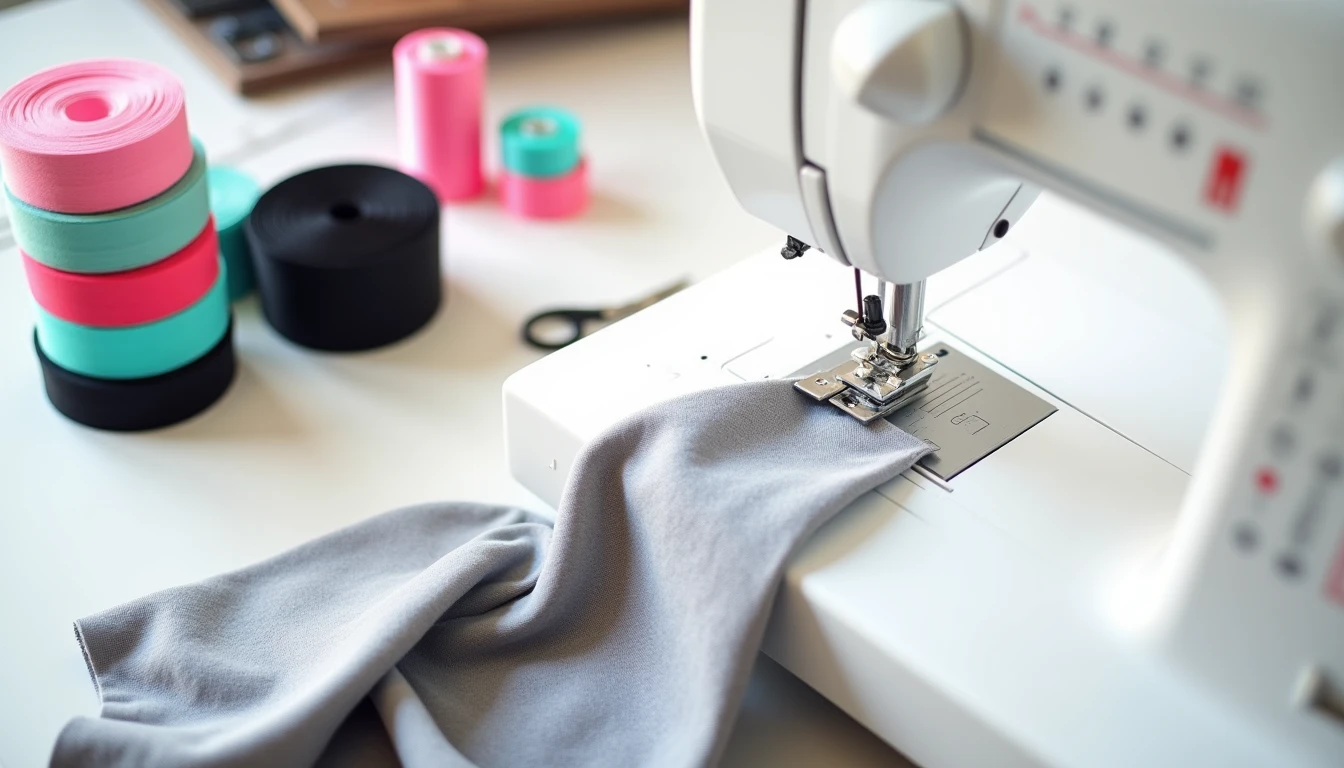
Fold over elastic, usually just called FOE, is a flat stretch tape with a crease down its exact center, so you fold it in half and it wraps around a raw fabric edge in one strip, the way bias tape does, except it stretches and snaps back into shape. Bias tape finishes an edge, but it doesn’t move with the body, so on anything knit, anything that needs to stretch around a leg, a head, or a waist, FOE just works better. It’s also fast once you get the hang of it, since there’s no separate elastic casing to sew. If you’re stocking up on notions for a project like this, our guide to sewing tools and notions covers what you’ll want on hand.
Some links below are affiliate links. Prices are 2025-2026 estimates and change often, so always check current pricing.
What Fold Over Elastic Actually Is
FOE is built with a center crease, so it folds in half lengthwise and encloses a raw edge the same way binding does, but with built-in stretch and recovery. Most FOE has two different faces: one shiny and satin-like, the other matte, plush, or “brushed.” You pick which side shows depending on the project, shiny for lingerie, matte or plush for softer applications like diapers or baby items.
The most common width is 5/8 inch (about 15-16mm), though it also comes in 3/8in, 1/2in, 3/4in, 1in, and up to 1.5in. The labeled width is the flat width before folding, so once folded over an edge it finishes at roughly half that. Fiber content is typically a nylon and spandex blend, commonly around 75-90% nylon to 10-25% spandex, which gives FOE a smooth hand and strong recovery.
- Braided elastic is ribbed, narrows when stretched, and loses resiliency if pierced by a needle, so it belongs in a casing, not under direct stitching.
- Knit elastic doesn’t narrow and tolerates being sewn through, but has no crease, so it can’t enclose a raw edge in one pass like FOE can.
- Bias tape encloses an edge the same structural way, but it’s woven, not elastic, so it lies flat instead of stretching.
Narrower FOE has more give and suits lightweight lingerie; wider FOE is sturdier and better for cloth diapers or loungewear waistbands.
How to Sew Fold Over Elastic
Two-pass method (most accurate for visible edges)
- With wrong sides together, line up the fabric’s raw edge at the FOE’s center crease, still open flat.
- With a small, narrow zigzag (about 2mm wide by 2.5mm long), stitch the FOE to the wrong side of the fabric, about 1/4 inch from the elastic’s inner edge, stretching it gently and evenly as you sew.
- Fold the FOE over the raw edge to the right side, hiding the first seam inside the fold.
- Topstitch along the free edge of the folded elastic with the same zigzag, catching both layers so no raw fabric peeks out.
One-pass method (faster, less forgiving)
- Fold the FOE in half lengthwise first, pre-pressing the crease.
- Feed the raw edge directly into the folded channel as you sew, using an edge-joining foot, a blindhem foot, or careful hand-guiding.
- Stitch through all layers in one pass with a zigzag or lightning stitch, stretching evenly.
Because the raw edge is hidden as you sew, this method is quicker but more prone to wobble on decorative edges like bra trim; wonder tape helps keep it centered.
Quartering method for openings (leg holes, waistbands, necklines)
Mark quarter points on both the opening and the elastic: center front, center back, and the two side points. Use the side seam as a landmark, since true center is often offset from the fold. Join the elastic into a loop first if needed, then quarter-mark the loop. Pin at quarter points first, then between them to spread the fullness evenly, and sew between pins in short sections, stretching each section to match its segment of fabric rather than pulling the whole length in one continuous stretch. Fold over and topstitch to finish, as above.
Joining FOE ends into a loop
Overlap the two cut ends by about 1/4 to 1/2 inch and stitch with a narrow zigzag and a 1/4 inch seam allowance. Trim the excess close to the stitching so it doesn’t add bulk, then treat the loop as a single length, matching the seam to a quarter point (usually center back) when quartering the opening.
How Much to Stretch It
This is where a lot of first FOE projects go wrong. On straight or gently curved edges, like a lingerie strap or a straight hem, stretch the elastic only slightly, roughly 1:1 with the fabric length, just enough to avoid puckering while keeping the edge flat.
On edges meant to gather in and hug the body, leg openings, waistbands, necklines, stretch more aggressively, commonly cited as about 80-90% of the elastic’s maximum stretch. Cloth diaper tutorials are a good example: pull FOE to about 80% stretch at the leg openings for a snug fit, but only about 20% elsewhere on the same garment, like the back waist. Same elastic, same project, two different ratios depending on the job.
Apply the stretch evenly and gradually, not yanked in one uneven pull. Uneven tension is the top cause of wavy or tunneling edges, which is why the quartering method exists.
Which Stitch to Use
A zigzag, narrow to medium (around 2-3mm wide by 2-2.5mm long), is the standard choice. For a refresher on stretch stitching basics, see our guides to sewing stretchy fabric and sewing machine stitches.
A three-step (multi-step) zigzag is a popular alternative because it spreads stitches across more contact points, reducing tunneling. A lightning-bolt stitch, on many home machines, works well too: it stretches with the elastic and often puckers less while staying nearly as stretchy as a full zigzag.
A straight stitch should never attach FOE, confirmed across multiple sewing sources: it has no give, so it will pop or restrict the elastic’s stretch and recovery. Use a ballpoint or stretch needle instead of a sharp one, so it slips between the elastic’s fibers rather than piercing them. A walking foot is optional but useful, feeding both layers through evenly instead of letting the top layer push ahead of the bottom.
Six Things to Make With FOE
Underwear and lingerie. The classic, original use of FOE, it’s how most ready-to-wear panties and bras are finished. Narrower widths (3/8-5/8in) suit lightweight tricot and lace, and the quartering method is standard for leg and waist openings.
Cloth diapers and training pants. FOE has a large maker following in cloth diapering because it finishes waterproof PUL leg and waist openings without a separate casing. Heavier, wider FOE (often 1 inch) in a plush finish is common, with the more aggressive 80% stretch at the legs for a snug, leak-resistant fit.
No-sew baby headbands. A short length, roughly 5 to 8 inches, can be overlapped and knotted or glued into a loop with no machine at all, a popular quick craft. For more small-project ideas, see our sewing for kids guide. 5/8in is the width most often recommended, soft against a baby’s skin while still holding shape.
DIY hair ties. Cut a length about 8 to 9.5 inches long, overlap the raw ends, and tie a tight knot to form a loop. One safety note: FOE is synthetic and will fray at the cut edge, so seal the ends by briefly passing them through a lighter or candle flame (use the flame’s blue base, don’t touch it directly) until the fibers darken and fuse. Do this carefully, briefly, and away from anything flammable.
Activewear necklines and armholes. Because FOE doesn’t narrow when stretched and holds its shape over repeated wear, it’s a solid way to stabilize knit necklines and armholes. For heavy-sweat activewear, some suppliers recommend polyester/elastane FOE over nylon/elastane for better color and recovery under washing.
Swimwear, with a caveat. FOE is sometimes used decoratively on swimwear, but dedicated swim elastic (a braided rubber or cotton blend built to resist chlorine and salt water) is the better choice for functional, load-bearing swim elastic. Standard FOE’s nylon/spandex build isn’t engineered for repeated water exposure, so save it for lightweight trim.
Troubleshooting Wavy Edges and Other Fails
Wavy, rippled, or tunneling edges. Usually from stretching too hard or unevenly instead of working in quarter-sections, a stitch that’s too dense (restricting the elastic’s recoil), or elastic too heavy for the fabric. Fix by quarter-marking and stretching evenly, switching to a three-step zigzag, lightening presser-foot pressure, using a walking foot, and pressing the finished seam on low heat afterward.
FOE slips off the raw edge. The raw edge needs to sit exactly at the center crease before folding, not off to one side. Careful pinning or an edge-joining foot keeps it centered. On the topstitch pass, sew right at the edge of the fold so both layers are caught; stitching too far in leaves the underside loose.
FOE melts or glazes when pressed. FOE is nylon-based with a low melting point, so press on a cool or low synthetic setting, use a pressing cloth, and test on scrap first.
Skipped stitches or the machine “eating” the elastic. Switch to a ballpoint or stretch needle, since a sharp needle can pierce and damage the fibers. Polyester or woolly nylon thread also helps, since it has give that matches the elastic’s stretch better than cotton.
Buying FOE
FOE is sold by the yard (often 1-5 yard packs) and on rolls (commonly 5-yard or 100-yard) at fabric shops and notions suppliers. The most stocked widths are 5/8in (all-purpose), narrower 3/8in and 1/2in for lingerie, and wider 3/4in and 1in for diapers and waistbands.
Color range is extensive, with solid lines often running 40+ shades and printed FOE (florals, sports prints, holidays) widely available, especially in 5/8in for hair ties and headbands. Nearly all FOE has that shiny satin face on one side and a matte or brushed face on the other, so decide upfront which side you want visible. If you want to browse options before committing, this search for fold over elastic is a decent starting point for widths and colors.
A stretch needle (see stretch sewing machine needles) or an edge-joining foot makes the whole process noticeably easier, especially the first few times.
Want more patterns to put your FOE skills to use on? Browse our library of 155+ printable PDF sewing patterns at Sewing Pattern Secrets.
Frequently Asked Questions
What is fold over elastic used for?
Fold over elastic (FOE) is used to finish and bind raw fabric edges while adding stretch, most commonly on underwear and bra edges, cloth diaper leg and waist openings, baby headbands, DIY hair ties, and knit necklines and armholes like activewear. Its center crease lets it fold over an edge in one strip, the way bias tape does, but with stretch and recovery built in.
How do you sew fold over elastic?
The most accurate method is two passes. First, zigzag the flat, unfolded elastic to the wrong side of the fabric with the raw edge at the elastic’s center crease, stretching gently as you sew. Then fold the elastic over the raw edge and topstitch along the folded edge with a zigzag to finish. A faster one-pass method feeds the raw edge directly into the pre-folded elastic as you stitch, but takes more practice to keep straight.
Do you stretch FOE while sewing?
Yes, but how much depends on the edge. On straight or lightly curved edges, stretch it only slightly to match the fabric length without puckering. On leg openings, waistbands, and necklines meant to gather and hug the body, stretch it more firmly, often around 80-90%, applied evenly in quarter-marked sections rather than pulled unevenly in one motion.
Can you use FOE for swimwear?
You can use it decoratively, but dedicated swim elastic (typically a braided rubber or cotton blend built to resist chlorine and salt water) is the recommended choice for functional, load-bearing swimwear elastic, since standard nylon/spandex FOE isn’t engineered to withstand repeated pool or ocean exposure the way swim elastic is.
How do you make hair ties out of fold over elastic?
Cut a length of FOE roughly 8 to 9.5 inches long, overlap the two raw ends, and tie them into a tight knot to form a stretchy loop, no sewing required. Because the nylon-based elastic frays at a cut edge, seal the raw ends by briefly passing them near or through a lighter or candle flame until the fibers darken and fuse, being careful not to hold the elastic directly in the flame.
What size FOE for baby headbands?
5/8 inch fold over elastic is the width most commonly recommended for baby headbands. It’s soft and gentle enough for an infant’s skin while still holding its shape, and a length of roughly 5 to 8 inches, adjusted to head size, is typical for a no-sew knotted headband.