If you have ever wrestled a queen-size quilt through the 7-inch throat of a domestic sewing machine, you already know why longarm quilting exists. Rolling and unrolling a heavy sandwich of top, batting, and backing while keeping free-motion lines even is a fight, and it is where a lot of finished quilt tops stall out in a closet. Longarm quilting is the escape hatch. You can hire a professional, rent time on a shop’s machine and do it yourself, or eventually buy your own. This guide covers what longarm quilting is, what it costs in 2025-2026, how to prep your top, and whether renting or buying makes sense for you. For the broader picture of machine quilting methods, see our quilting techniques hub.
Some links below are affiliate links. Prices are 2025-2026 estimates and change often, so always check current pricing.
What a Longarm Actually Is
The difference comes down to the throat, the distance between the needle and the machine’s body. Domestic machines give you 6 to 9 inches of throat space, and even machines marketed for quilting rarely stretch past 10 or 11 inches, a small window to shove a bulky quilt through and why domestic quilting turns into a wrestling match on anything bigger than a lap quilt.
A true longarm has an 18 to 30 inch throat mounted on a stationary frame 8 to 14 feet long. Mid-arm machines split the difference at 12 to 18 inches on shorter frames.
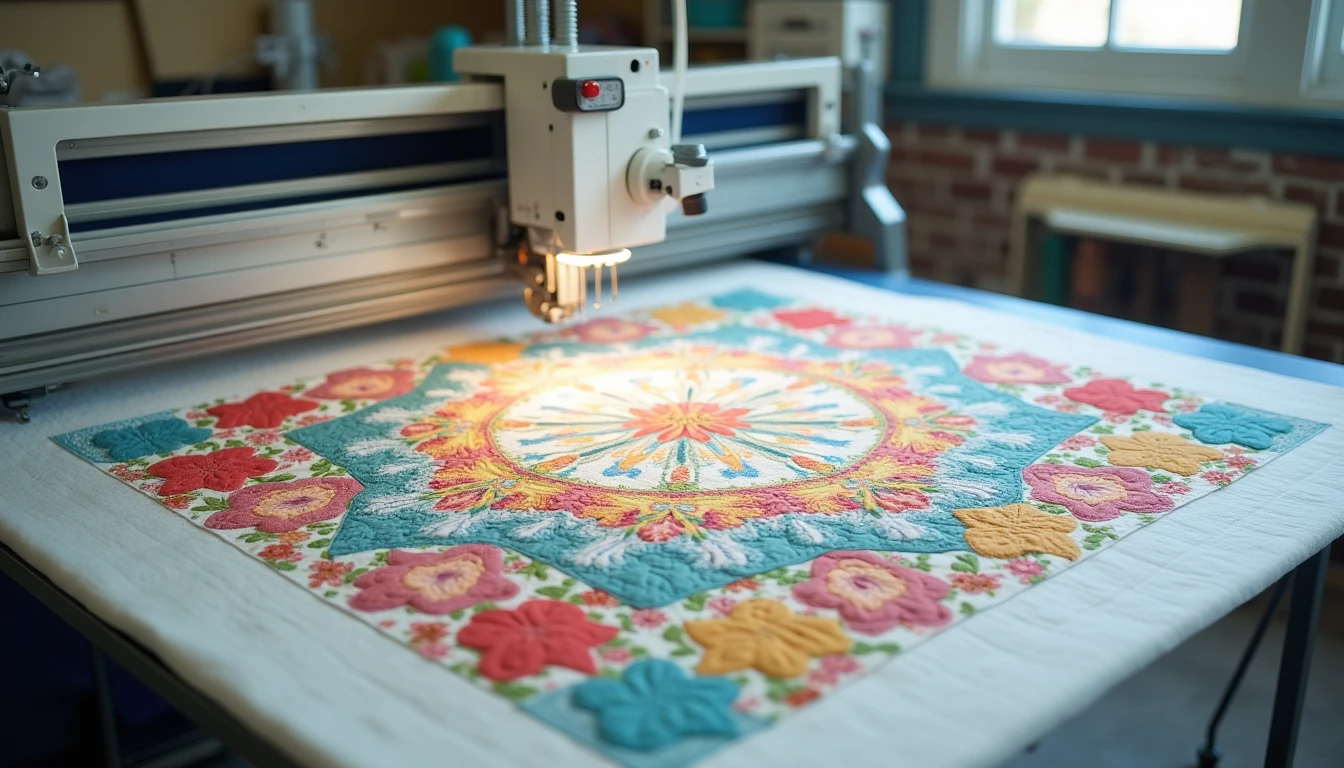
The mechanics are flipped from what you know. On a domestic machine, you feed the quilt past a needle that stays put. On a longarm, the quilt stays still, loaded onto rollers at the front, back, and sides of the frame, while the sewing head glides over the top on rails, guided by hand or by computer. The rollers hold all three layers taut as they load, so longarm quilting skips basting entirely: no safety pins, no spray adhesive, no crawling around pinning layers together. For the fundamentals, see our quilting for beginners guide.
Service Tiers Decoded
When you hire a longarm quilter, you are usually choosing between three tiers, and the tier drives most of the price.
Edge-to-edge, often called E2E or pantograph, stitches one continuous, pre-set design uniformly across the whole quilt, regardless of the pieced pattern underneath. It is the fastest and cheapest option, and what most quilt shops default to.
Semi-custom pairs a base allover pattern in the body with a different design in the borders or sashing, or motifs sized to nest into individual blocks, adding visual interest without full custom pricing.
Custom, sometimes called heirloom, is where the quilter designs stitching specific to each element: ditching around the piecing, feathers in the setting triangles, dense background fill, occasionally trapunto. It takes far more design time and slower stitching, so it costs more. Browsing pantograph and quilting design options helps you see what each tier looks like before you commit.
What It Costs
Longarm services are usually priced per square inch of the finished quilt top (length times width), not by the hour, for E2E and semi-custom work. 2025-2026 pricing typically lands:
- Edge-to-edge/pantograph: about $0.02 to $0.035 per square inch, depending on design density
- Semi-custom: roughly $0.03 to $0.04 per square inch
- Custom/heirloom: $0.04 to $0.10+ per square inch, or billed hourly ($30-$60+/hr) for the most elaborate work
Here is the queen-size math, since it is the size most people budget for. A queen top at 90 by 95 inches works out to 8,550 square inches (see our quilt size and measurements guide to check your own top’s dimensions). At a typical E2E rate of $0.025 per square inch, that is about $214 for quilting alone, closer to $171 at the $0.02 low end and $299 at the $0.035 high end. Semi-custom at $0.035 lands near $299 too, and true custom rates of $0.06 to $0.08 push it to $513-$684. A smaller lap quilt around 54 by 60 inches (3,240 sq in) runs about $81 at $0.025, which is why most shops set a minimum charge, commonly around $50.
Batting and thread are usually extra: batting runs $15 to $40 or more, and some shops charge roughly $1 per bobbin of thread while others fold it into the base rate, so ask up front. Turnaround commonly runs 2 to 4 weeks, with rush service, often around a week, available for a fee. Mail-in quilting is common since good longarm quilters are not evenly spread out geographically.
Prepping Your Top
Whether you hire out or rent time yourself, prep work separates a clean finished quilt from one with visible flaws.
- Press the top thoroughly, including seam allowances flat on the back. Puckers and unpressed seams get quilted in permanently.
- Press the backing too, piecing it if needed with seams pressed open so it lies flat.
- Make the backing at least 4 inches larger than the top on all four sides (8 inches total in each dimension). A 60×80 inch top needs roughly a 68×88 inch backing, since the frame’s clamps grip the outer edges and that margin is lost to loading. Wide quilt backing fabric or a basting spray and pin set are worth having on hand, even though basting itself is not needed for a longarm.
- Square up the backing, especially the top and bottom edges, so it loads evenly without skewing the quilting.
- Clip stray threads from the back, particularly on light fabrics, since dark threads can shadow through once layers are compressed and lit from behind.
- Do not baste or pin the layers together. The quilter loads backing, batting, and top as three separate layers; pre-basted layers make the job harder and can get your quilt refused.
- Mark the top edge of both pieces with a pin or sticky note so the quilter knows the intended orientation for directional prints or panto direction.
- Avoid borders that flare or ripple. A border added without easing will not lie flat and will show as puckering. Measure through the center of the quilt, not the stretchy outer edge, when cutting borders.
Renting Time on a Longarm
If you like the hands-on part of quilting and want creative control, renting time on a shop’s longarm can beat sending your top out. Almost every shop requires a certification class first, a one-time 3 to 5 hour session covering machine anatomy, thread tension, safe handling, and loading a quilt, usually $50 to $150, with some shops applying the fee toward your first rental hours.
Once certified, hourly rates commonly run $15 to $25 for hand-guided machines and $25 to $44 for computerized ones with pattern-following capability. Renting starts to make financial sense once you are quilting several tops a year, since the math can beat per-square-inch service fees, and it is more fun for people who want to be involved in every step.
Be honest about the learning curve, though. Your first sessions will likely be slower than expected, tension will need adjusting, and mistakes are yours to fix or pay for. Most shops recommend practicing on a cheap “practice quilt,” a bed-sheet sandwich, before loading a top you actually care about.
The Buying Math (Honest)
Buying your own longarm is a real investment, not an impulse purchase, and most hobbyists never need one. New mid-tier machines from brands like Handi Quilter, APQS, Gammill, and Innova, paired with a frame, run $10,000 to $40,000 or more, with computerized stitch-regulation models at the top. Entry-level and used setups run roughly $5,000 to $12,000. A frame also needs 8 to 14 feet of dedicated floor space, which rules it out for most home sewists without a spare room or converted garage.
Buying tends to pencil out when you are quilting for others as a paid service, since the income can offset the cost over time, or when you finish many quilts a year at guild or professional volume. For hobbyists finishing a handful annually, the math rarely works compared to paying a service or renting a few hours.
A middle-ground option is a sit-down midarm: a 16 to 20 inch throat machine used without a frame, on a table like an oversized domestic machine, where you move fabric under a mostly stationary head with far more workspace. These run roughly $3,000 to $6,000, occasionally more, and need no dedicated frame room, a useful step for quilters who have outgrown a domestic throat but cannot house a full rig. Bottom line for most hobby quilters: a domestic machine with a walking foot handles smaller quilts fine, and there is no need to buy a longarm to finish quilts occasionally. Renting or sending work out stays cheaper until your volume justifies ownership.
If you would rather spend your quilting budget on patterns than machinery for now, our library of 155+ printable PDF sewing patterns is worth a look while you plan your next project.
Frequently Asked Questions
What is longarm quilting?
Longarm quilting is machine quilting done on a specialized machine with a long throat (18 to 30 inches) mounted on a frame. The quilt stays still while the sewing head moves over it, stitching top, batting, and backing together without pre-basting.
How much does longarm quilting cost?
Most services charge $0.02 to $0.035 per square inch for edge-to-edge/pantograph, $0.03 to $0.04 for semi-custom, and $0.04 to $0.10 or more for custom/heirloom work, plus batting and sometimes thread. A queen quilt (about 8,550 sq in) typically runs $170 to $300 for E2E, with a shop minimum, often around $50.
How do I prepare my quilt top for a longarm quilter?
Press the top and backing well, make the backing at least 4 inches larger than the top on every side, square it up, clip stray threads, mark the top edge for orientation, and do not baste or pin the layers together. The quilter loads each layer separately onto the frame.
What is the difference between edge-to-edge and custom quilting?
Edge-to-edge (E2E) stitches one continuous repeating design uniformly across the whole quilt regardless of the piecing underneath, and is the fastest, cheapest option. Custom quilting is designed around your specific top, with different motifs and denser fill or feathers, taking far more time and skill, so it costs noticeably more, often billed hourly for heirloom work.
Can I rent time on a longarm machine?
Yes. Many quilt shops rent longarm hours, usually after a required certification class (roughly $50 to $150, often a 3 to 5 hour session). After that, hourly rental typically runs $15 to $25 for hand-guided machines and $25 to $44 for computerized ones.
Is buying a longarm machine worth it?
Only for high-volume quilters or those quilting professionally. New longarm-and-frame setups run roughly $10,000 to $40,000 or more (used/entry setups $5,000 to $12,000) and need 8 to 14 feet of dedicated floor space. Most hobbyists are better off renting time or paying a mail-in service; a sit-down midarm (roughly $3,000 to $6,000) is a cheaper middle ground.