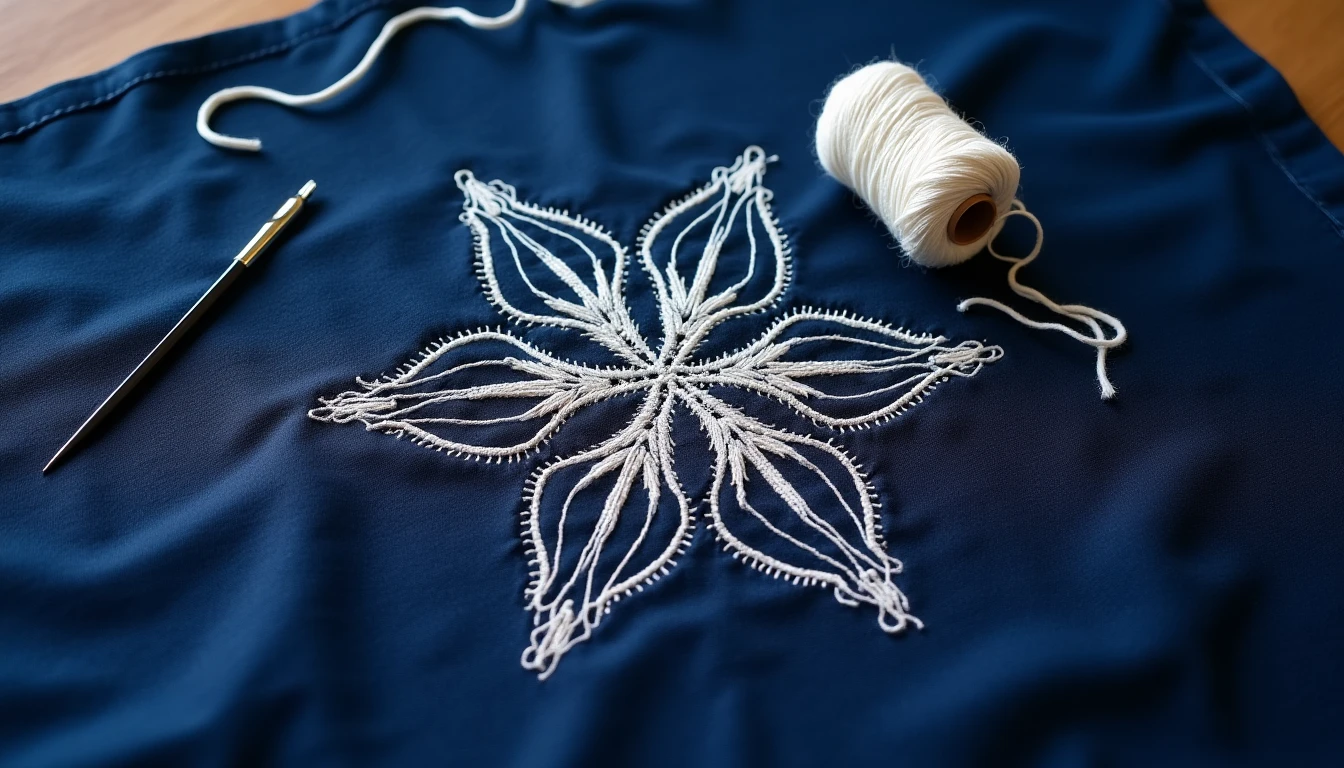
Sashiko starts with a stitch most of us already know: the running stitch, the same in-and-out line you’d use to baste a hem or gather fabric. What makes sashiko different is what generations of Japanese stitchers did with it. Working from real necessity, cold winters, thin cloth, cotton that was hard to come by, they turned that plain stitch into reinforcement, warmth, and eventually pattern. This page covers where sashiko comes from, the tools and technique that set it apart from ordinary embroidery, the classic motifs worth learning, and how the tradition shows up today in visible mending.
Some links below are affiliate links. Prices are 2025-2026 estimates and change often, so always check current pricing.
What Sashiko Is (and Where It Comes From)
Sashiko (刺し子) translates to “little stabs.” The word comes from sasu, the verb for piercing or stabbing, combined with -ko, a diminutive suffix, a plain name for a plain technique.
The tradition is first documented in Japan’s Edo period (1603 to 1868), among farming and fishing families in rural and northern Japan, particularly the cold Tōhoku region. Cotton was expensive and hard to grow that far north, so families stitched layers of scrap fabric onto thin hemp and cotton garments to reinforce them, add warmth, and stretch the life of cloth that couldn’t be replaced. That patch-over-patch mending, repeated across generations, is what eventually produced boro: the heavily layered, visibly repaired textiles now collected as folk art. Boro isn’t a separate craft from sashiko. It’s the accumulated result of sashiko stitching over time, one garment mended so many times it became its own kind of cloth.
The white-thread-on-indigo look wasn’t purely aesthetic either. Edo-era sumptuary laws restricted rural commoners, farmers, fishers, artisans, to plain hemp and cotton dyed in indigo, while bright colors and fine silk were reserved for samurai and merchants. Stitching white cotton thread onto indigo cloth let ordinary people build pattern and skill into their clothing without breaking those restrictions.
It’s worth being careful with how boro gets talked about now. For a long time this mending was tied to poverty and was hidden rather than shown. Sashiko artisan Atsushi Futatsuya, a third-generation practitioner who teaches through Upcycle Stitches and Sashi.Co, has pushed back on the idea that this was accidental or purely functional. He argues rural stitchers deliberately chose thread and patch placement to make their clothing attractive within what they had, simple human instinct rather than a random byproduct of hardship. Sashiko shifted toward a decorative, now globally popular craft only from the 20th century onward, after Japan’s mingei folk-craft movement and later textile collectors reassessed it as meaningful art rather than evidence of poverty.
So how does sashiko differ from embroidery generally? Embroidery covers a wide range of stitches, threads, and techniques developed mainly for decoration. Sashiko is narrower and older in purpose: one stitch, thicker single-strand thread, worked on plain-woven cloth, historically for mending fabric long before it became something people did for beauty alone.
The Tools (and Why They’re Different)
Sashiko needles are longer, straighter, and more rigid than a standard embroidery needle, with an eye sized for thicker thread. The length matters for a specific reason: instead of pulling the thread through after every stitch, you load several stitches onto the needle first, then draw it through in one motion. A short, flexible needle can’t do that.
Sashiko thread is tightly twisted, matte, and made from long-staple 100% cotton, sold as a single strand rather than something you split into plies. Common brands are Olympus and Daruma (Daruma runs a tighter twist, Olympus a bit looser and thicker-looking). It’s genuinely not the same material as embroidery floss, which is glossier, more loosely constructed, and meant to be separated into individual strands. Sashiko thread is used as-is, and that single sturdy strand is part of why the finished stitching has its flat, matte texture.
A thimble helps push the rigid needle through cloth, especially through multiple layers of denim or boro-style patchwork. The traditional version is a yubinuki-style palm thimble, worn like a ring on the middle finger, with the needle’s eye braced against a plate on the palm side. To lay out a pattern beforehand, most people mark a grid with a hera (a traditional tool pressed along a ruler to score a crease line, no ink needed), tailor’s chalk, a wash-away pen, or white transfer paper for dark indigo cloth.
If you want proper materials instead of substituting regular embroidery supplies, a sashiko thread and needle set gets you the long needle and single-strand cotton thread in one purchase.
The Technique
- Sashiko is a running stitch: the needle passes over and under the cloth in a straight line with even spacing between stitches.
- The traditional convention is that front stitches run slightly longer than the gaps and the stitches on the back, often cited as roughly a 3:2 ratio. Treat that as a guideline, not a rule. Actual lengths run about 2 to 7mm depending on the teacher and the project, and individual stitchers vary it.
- Because the needle is long and rigid, you load several stitches onto it in a rocking motion before pulling the thread all the way through, rather than tightening after each stitch.
- Keep the thread a little slack rather than pulled tight. Sashiko is meant to lie flat, and pulling too tight puckers the cloth. Many stitchers gently tug the finished piece lengthwise and diagonally now and then to settle the slack evenly into the weave.
- At corners and direction changes, leave a small loop of slack on the back, roughly 3 to 5mm, so the stitching doesn’t strain when the fabric flexes.
- Traditional practice generally skips knots at the start and end of a thread. Instead, stitchers take a few small overlapping backstitches to anchor the thread invisibly. That said, this varies by teacher, and plenty of modern how-tos use a small knot for simplicity. Neither is wrong.
- For hitomezashi grid patterns, stitch in order: complete every stitch running one direction first (all the horizontal lines, say), then go back and stitch the perpendicular lines. Don’t mix directions row by row.
The Classic Patterns
Sashiko motifs split into two families. Moyozashi (“pattern stitching”) uses long, flowing, curving lines that never cross themselves, building organic or pictorial motifs. Hitomezashi (“one-stitch stitching”), strongly associated with Japan’s Shōnai region, works on a strict grid where stitches deliberately meet or cross at regular intervals, producing graphic, lattice-like designs. If you’re picking a first pattern, hitomezashi is usually the easier start, since the even grid makes it simple to check your own spacing as you go.
A few patterns worth knowing:
Asanoha (hemp leaf), moyozashi. Interlocking star-like diamonds echoing hemp leaves, traditionally stitched on children’s clothing as a wish for healthy, fast growth, since hemp grows straight and quickly.
Shippo (seven treasures), moyozashi. Overlapping circles forming a repeating four-petal shape where they intersect, named for the seven treasures of Buddhist scripture and symbolizing harmony and prosperity.
Seigaiha (blue ocean waves), moyozashi. Repeating overlapping arcs representing calm, endless waves and symbolizing resilience and continuity. It shows up widely outside sashiko too, in ceramics and family crests.
Kagome (woven bamboo eyes). A lattice of interlocking triangles mimicking a woven bamboo basket, traditionally considered protective, echoing the old custom of hanging woven baskets by doorways to ward off misfortune.
Yarai (bamboo fence). Diagonal crossing lines resembling a bamboo fence, associated with protection and stability.
Kaki no hana (persimmon flower), hitomezashi. One of the best-known grid patterns, built purely from horizontal and vertical stitches, valued for how much visual complexity comes out of such a simple structure.
Sashiko and Visible Mending
Sashiko has become a cornerstone of visible mending worldwide, and denim patching is the most visible example. A patch of woven or scrap fabric is stitched behind or over a hole or worn spot using even running stitches, sometimes in a grid or one of the motifs above, turning the repair into a design feature instead of something you hide. If you’re patching jeans specifically, our jeans stitching guide walks through placement and spacing in more detail, and it pairs naturally with our broader mending and alterations guide for repairs beyond denim.
Boro-inspired layering, deliberately combining fabric scraps and stitching several generations of visible repair into one piece, draws directly from this history. Handle that crossover with some care. Sashiko and boro came out of real economic necessity and, for a long time, real social stigma in rural Japan, not a fashion aesthetic. Atsushi Futatsuya, who teaches sashiko internationally, frames it as more than a decorative technique: the original stitchers put real intention into function and appearance at the same time, and he encourages people picking up the craft now to carry that same thoughtful, resourceful spirit forward rather than treat the look as a disconnected trend. Crediting the tradition when you borrow from it costs nothing and matters.
Getting Started
You don’t need hand-marked traditional cloth for your first project. Pre-printed sashiko fabric panels, with a wash-away or iron-away grid already on them, are sold specifically for practicing hitomezashi and moyozashi patterns and make a low-barrier way to start. Another shortcut: stitch a hitomezashi grid directly onto gingham check fabric. The woven checks already give you an evenly spaced grid, so there’s nothing to mark at all.
From there, start small. Coasters, a simple sampler square, or a small drawstring pouch let you practice even stitch length and the loaded-needle rocking motion before you commit to a full garment or a mending project where mistakes are harder to unpick.
If you’d rather work from a printed pattern while you build up these skills, our library has 155+ printable PDF sewing patterns you can print at home and start stitching from today.
Frequently Asked Questions
What does sashiko mean?
Sashiko means “little stabs.” It comes from the Japanese verb sasu (to pierce or stab) combined with the diminutive suffix -ko, describing the small running stitches that make up the technique.
What is the difference between sashiko and embroidery?
Sashiko uses long rigid needles and thick, single-strand cotton thread on plain-woven cloth, historically for mending fabric before it became decorative. General embroidery covers a much wider range of stitches and threads, including stranded floss meant to be split into plies, and developed mainly for decoration rather than repair.
What thread do you use for sashiko?
Traditional sashiko thread is a tightly twisted, matte, long-staple 100% cotton thread, sold as a single strand rather than separable plies. Common brands are Olympus and Daruma. It isn’t the same as stranded embroidery floss, which is glossier, more loosely twisted, and designed to be split apart.
What is boro?
Boro refers to Japanese textiles, typically old work jackets or blankets, that were mended and patched repeatedly over generations using sashiko stitching. It’s the accumulated result of long-term mending rather than a separate craft, and it was historically associated with rural poverty before being reassessed as significant folk textile art.
What is the hemp leaf pattern?
The hemp leaf pattern, asanoha, is one of the most recognizable sashiko motifs: interlocking star-shaped diamonds that resemble hemp leaves. It traditionally symbolizes healthy, fast growth, echoing how quickly and straight hemp plants grow, and was often stitched onto children’s clothing for that reason.
Can I use sashiko to mend jeans?
Yes. A patch is stitched behind or over a hole or worn area of denim using even running stitches, often in a grid or traditional motif, turning the repair into a visible, deliberate feature rather than an invisible fix.